

DOE/Firepot
With the help of another engineer, I completed a 5-factor DOE and then 2 more smaller DOEs afterwards to dial-in the design of the firepot, the heart of a Traeger grill. Traeger has patents on the firepot, and it's arguably the most sensitive component, so it was very important to get this right. Additionally, with 2 different size grills, the thermal systems were different and therefore had to be tested with independent DOEs, hoping that the results aligned.
The driving force behind the DOE was a phenomenon called "pucking," where noncombustible material builds up on the firepot floor and prevents ignition. A primary metric for the DOE was puck mass after a certain amount of grill run time. Throughout the DOE, I used configurations to design 60+ variations of the firepot for a local manufacturer and then oversaw manufacturing for production via our primary supplier.

01
Measuring Firepot Mass before Grill Run
The grill has not been run with this firepot, so the mass shown is purely the mass of the part itself. B1-L is the name of the firepot being tested.
02
Measuring Firepot Mass after Grill Run
As you can see, this same firepot gained about 4 grams of incombustible matter via "pucking." This was a relatively low amount compared to others, but some firepot designs regularly yielded 0-2 grams and were considered better.

03
Qualitative Evaluation of Firepot
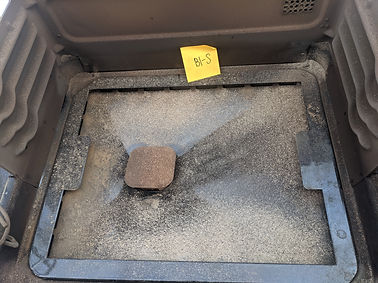
It was important for us to check the other parts of the grill (manifold, drip tray) to ensure that the ash made it into the ash bucket--that means it would not stick to the food. We took pictures after each run and noted any that looked particularly bad, such as this one...
04
Firepot Final Design
After running all the data through Design Expert software (similar to MiniTab), a value for each of the 5 factors mentioned above were selected, and the design was sent for manufacturing. The cut-and-fold firepot works beautifully!


05
Firepot Final Design (Side View)
The firepot was a 4-piece design; it could have easily been a 3-piece, but the rear flange was different for the small and large grills (due to internal grill geometry), so having that 4th piece allowed for a more modular design and simpler tooling.